Hiring Decisions You Can Defend
Exterview + Microsoft Work IQ will be the First Agentic Talent Intelligence Platform for Enterprise Hiring.

Hiring Decisions You Can Defend
Evidence-based talent evaluation, built on Microsoft Work IQ — and available without it.
The next generation of talent technology will not be another Applicant Tracking System, another skills database, or another dashboard of static reports. It will be a system that reasons.
Reasoning requires evidence. In most enterprises, the evidence of what someone can actually do is scattered across systems that were never designed to inform each other: the ATS holds the pipeline, the HRIS holds the record, interview quality lives in individual scorecards, and the operational context of the team doing the hiring lives nowhere at all.
Exterview is built to close that gap. This post explains how, including how we use Microsoft Work IQ for organizations running Microsoft 365, and how we deliver the same evaluation outcomes for organizations that do not.
The problem with self-reported talent data
Talent decisions have long rested on structured records: resumes, job descriptions, ATS entries, HRIS fields, skills inventories, performance reviews.
Each is a claim. Few are evidence.
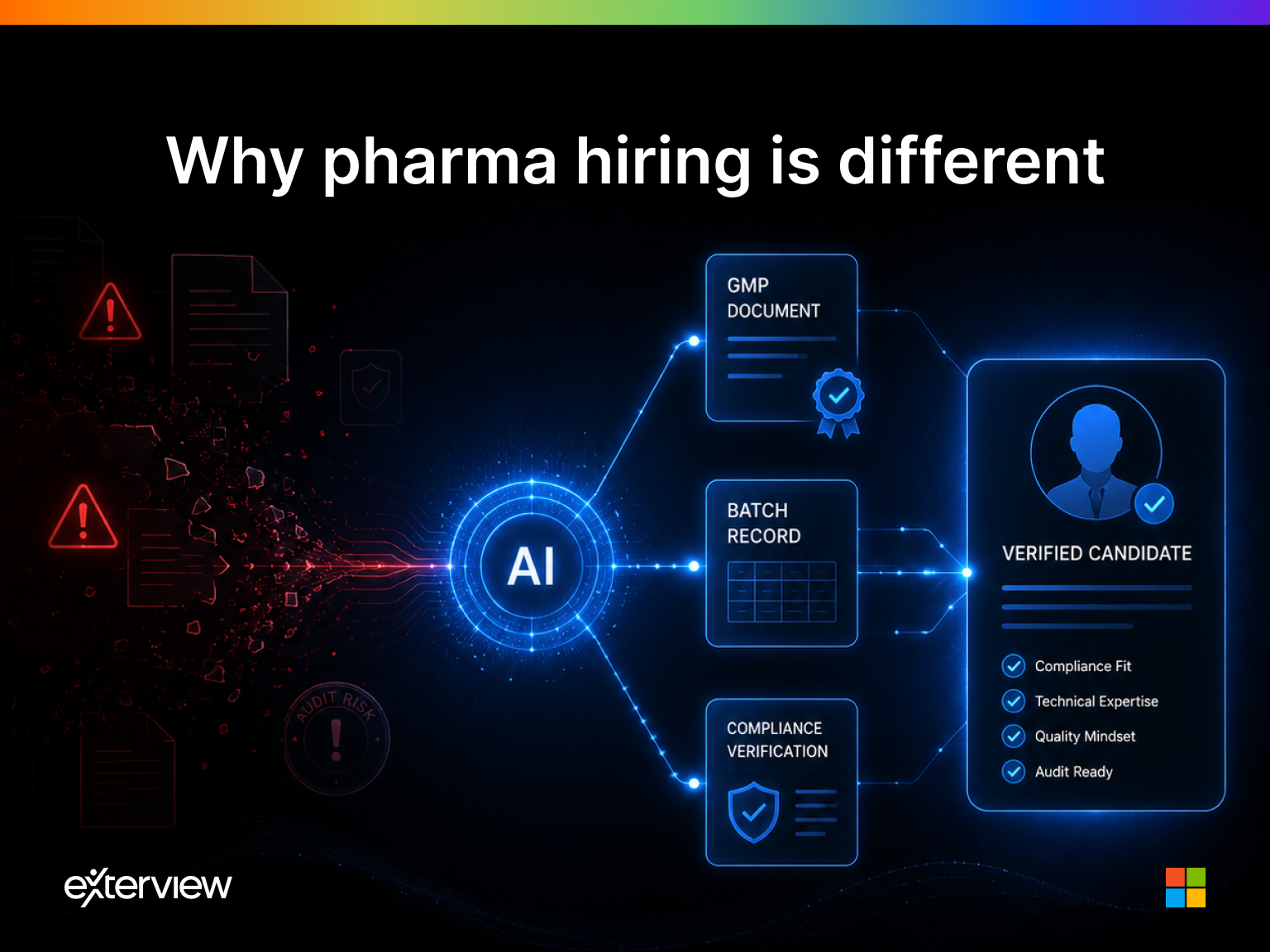
A resume states experience. A skills inventory states intent. A performance review states a manager's recollection at a point in time. None captures what a candidate demonstrated in an interview, or how a hire performed once the role began — and none can tell you whether the standard you applied was the right one.
Exterview is designed around one principle: a talent decision should trace to observable evidence, be scored against the organization's own standard, and be revisited once the outcome is known.
Two deployment paths, one evaluation model
Workplace context is an enrichment layer in our architecture, not a dependency. There is no Microsoft 365 prerequisite, no Copilot licence prerequisite, and no stack migration required to get value in the first month.
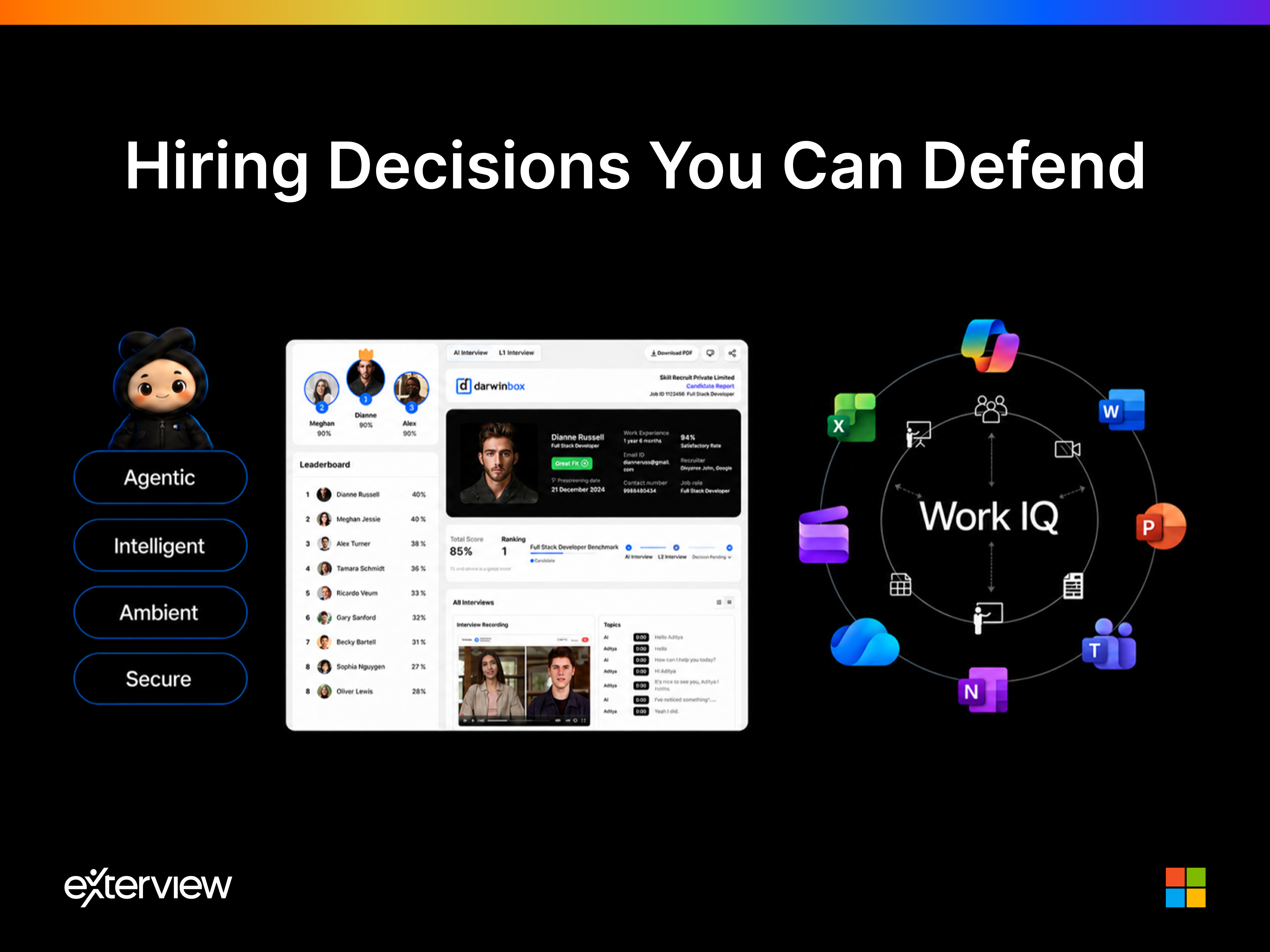
Exterview Core. For any customer, on any stack. Exterview ingests role definitions, interview structures, assessment output, transcripts, and scoring rubrics from your existing ATS or HRIS. The evaluation agents reason over that evidence and produce structured, auditable assessments.
Exterview with Microsoft Work IQ. For customers on Microsoft 365, Work IQ supplies organizational context to the same evaluation model.
The scoring logic, the audit trail, and the reporting surface are identical on both paths. Work IQ makes the input richer. It does not change the standard, and it does not change who owns the model.
How Work IQ actually works
This is worth being precise about, because Work IQ is routinely described as a set of connectors, which is close to the opposite of what it is.
See content credentials
Microsoft describes Work IQ as the intelligence layer that personalizes Microsoft 365 Copilot to an organization — the brain behind Copilot that understands context, relationships, and work patterns, and is explicitly positioned as faster, more accurate, and more secure than approaches built on connectors alone. It comprises three integrated layers.
Data. Secure access to structured and unstructured data across the Microsoft 365 tenant — permission-based, information-protected content in SharePoint and OneDrive, Outlook email, and Teams meetings and chats — together with metadata and signals describing patterns of action, collaboration, and communication over time. Business data from other systems can be brought into the tenant through Copilot Connectors, with hundreds of pre-built connectors available or custom ones built as needed.
Context. A semantic index that performs meaning-based retrieval rather than keyword matching, returning a bounded set of relevant candidates for downstream processing. Indexed content retains existing security, privacy, and governance policies, including permissions, sensitivity labels, and tenant boundaries. Above this sits Copilot memory and a business-understanding layer built from ontologies and glossaries that capture procedural knowledge from existing workflows.
Skills and tools. Specialized instructions that help Copilot and agents perform specific tasks with greater speed and accuracy — Microsoft cites accessing meeting details and transcripts as one such deployed skill — paired with the tooling that executes them, including MCP server tools, agent flows, APIs, and plugins.
Two consequences matter for talent evaluation.
A query returns reasoned context, not a document set. Exterview does not receive a mailbox, a chat log, or a file and then interpret it. It asks a bounded question and receives an answer assembled inside the tenant. The Work IQ API exposes this intelligence through a standard interface, and applications calling it inherit Microsoft's identity, security, permissions, and regulatory compliance rather than reimplementing them.
The answer is shaped by who asked. Work IQ is designed to respect existing user permissions, Security Group assignments, sensitivity labels, and Data Loss Prevention policies, with stated commitments to GDPR and the EU Data Boundary.
Exterview adds a second ceiling on top of Microsoft's. An agent's effective permissions resolve as the intersection of what the agent is declared to do, what the workflow grants it, and what the invoking user already holds — never the union. An agent can never exceed the user, and can never exceed its own declaration. A senior administrator driving a resume-scoring agent still gets only the two permissions that agent declares. Every write action requires explicit confirmation; reach is not autonomy.
We treat these constraints as product features. Exterview does not profile employees, score collaboration behaviour, or infer leadership potential from communication patterns. That is monitoring, not talent intelligence, and it does not survive enterprise review in any regulated market we sell into.
What we do with it
Five capabilities, all scoped inside an active hiring workflow. Each maps to a specific Work IQ layer, and each states what the Core path substitutes.
1. Requisition context assembly. Before a role opens, the agent assembles the operating context around it what the team is currently working on, what the hiring manager has stated as priorities, how comparable roles were filled before so the role definition reflects the actual job rather than a reused template.
This is the capability that gains most from the context layer, because the inputs are narrative rather than structured. Semantic retrieval resolves the question in one bounded pass instead of Exterview stitching together calendar, document, and project signals itself.
Without Work IQ: the same agent runs against role history, prior requisitions, and structured intake from your ATS. The role definition is still generated and still auditable; it draws on hiring history rather than live operating context.
2. Interview evidence consolidation. Panel interviews fragment signal across scorecards submitted at different times, transcripts of varying quality, and follow-up discussion that never reaches the ATS. Exterview consolidates these into a single structured evaluation in which every conclusion carries a link to the evidence that produced it.
Work IQ contributes the panel's own coordination context — which interviewer covered which competency, where the decision was actually made, which concerns surfaced after the formal debrief. The evaluation object itself is constructed by Exterview and stored as a durable artifact under the tenant's own partition.
Without Work IQ: consolidation runs on scorecards, transcripts, and assessment output. This path loses post-debrief discussion, which is a genuine reduction in signal. We say so during implementation rather than at renewal.
3. Transcript and assessment reasoning. Interview transcripts are retrieved through native Microsoft 365 sources rather than third-party recording bots — accessing meeting details and transcripts is a Work IQ skill, not something a vendor needs to bolt on — then reasoned against the role's competency model. Each competency resolves to a score with cited evidence.
A dedicated evaluation agent then grades that output for bias and unsupported inference before anything reaches a scorecard. That agent is permanently read-only, enforced server-side. A tenant can configure the agents that produce evaluations; it cannot configure the agent that checks them. A customer able to soften its own bias check can route a weak rubric through a clean scorecard, which is a governance failure whether or not anyone intends it. Visible and immutable is the right pairing, and it is what an ISO 42001 or New York City Local Law 144 review asks to see.
Without Work IQ: transcripts arrive from your conferencing or assessment platform. All downstream reasoning is identical.
4. Recruiter operating context. Scheduling load, panel responsiveness, stage velocity, and stakeholder coordination, surfaced as operational intelligence for the team that owns the requisition. This is where the data layer's collaboration and communication signals do most of the work, because the signal lives in calendars and coordination patterns rather than in the ATS.
One deliberate limit: this is scoped to recruiting operations on live requisitions. It does not extend to employees outside the hiring team, and it produces no behavioural profile of any individual.
Without Work IQ: stage velocity and pipeline throughput come from ATS event data. Panel responsiveness and coordination load do not.
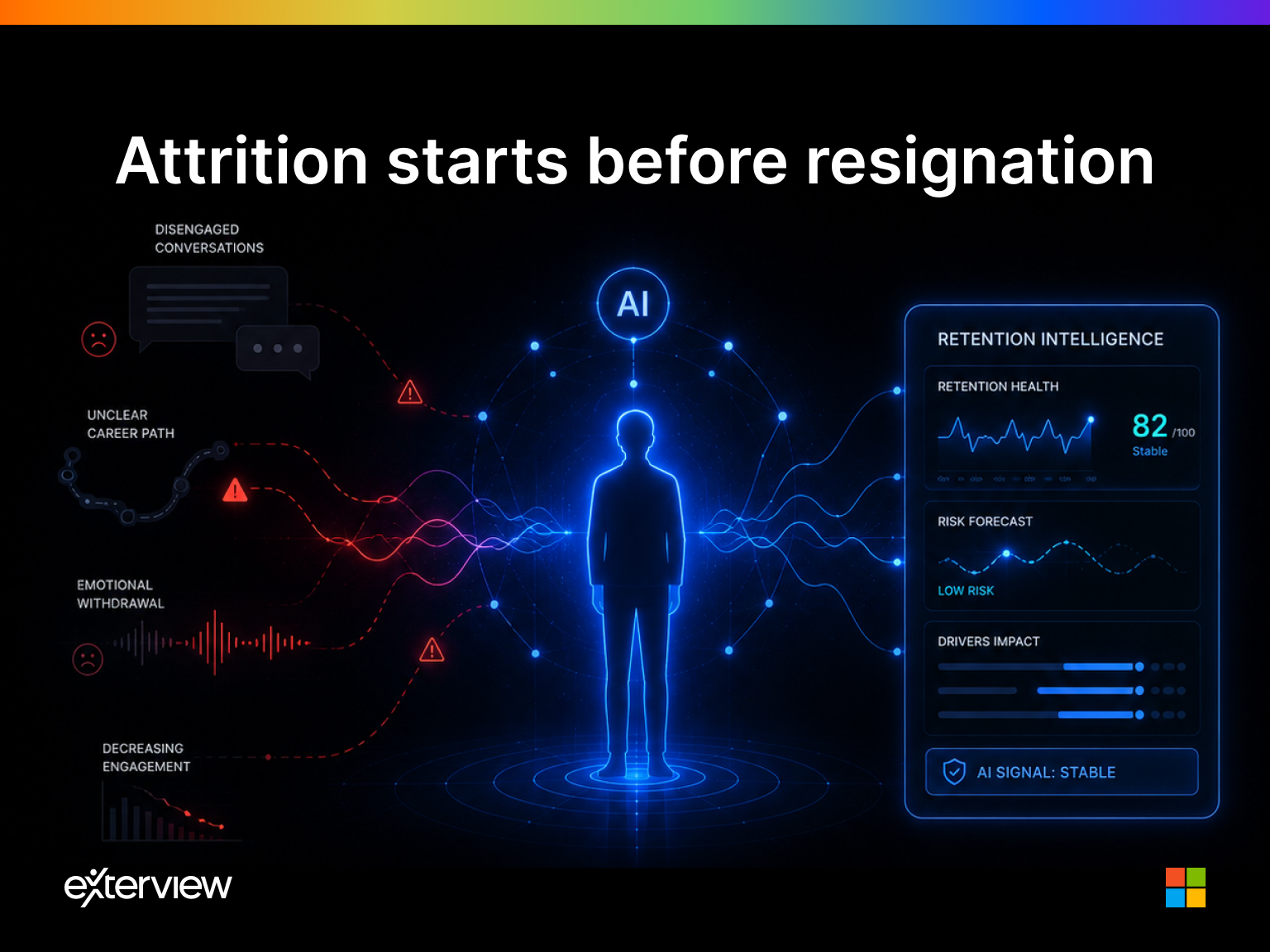
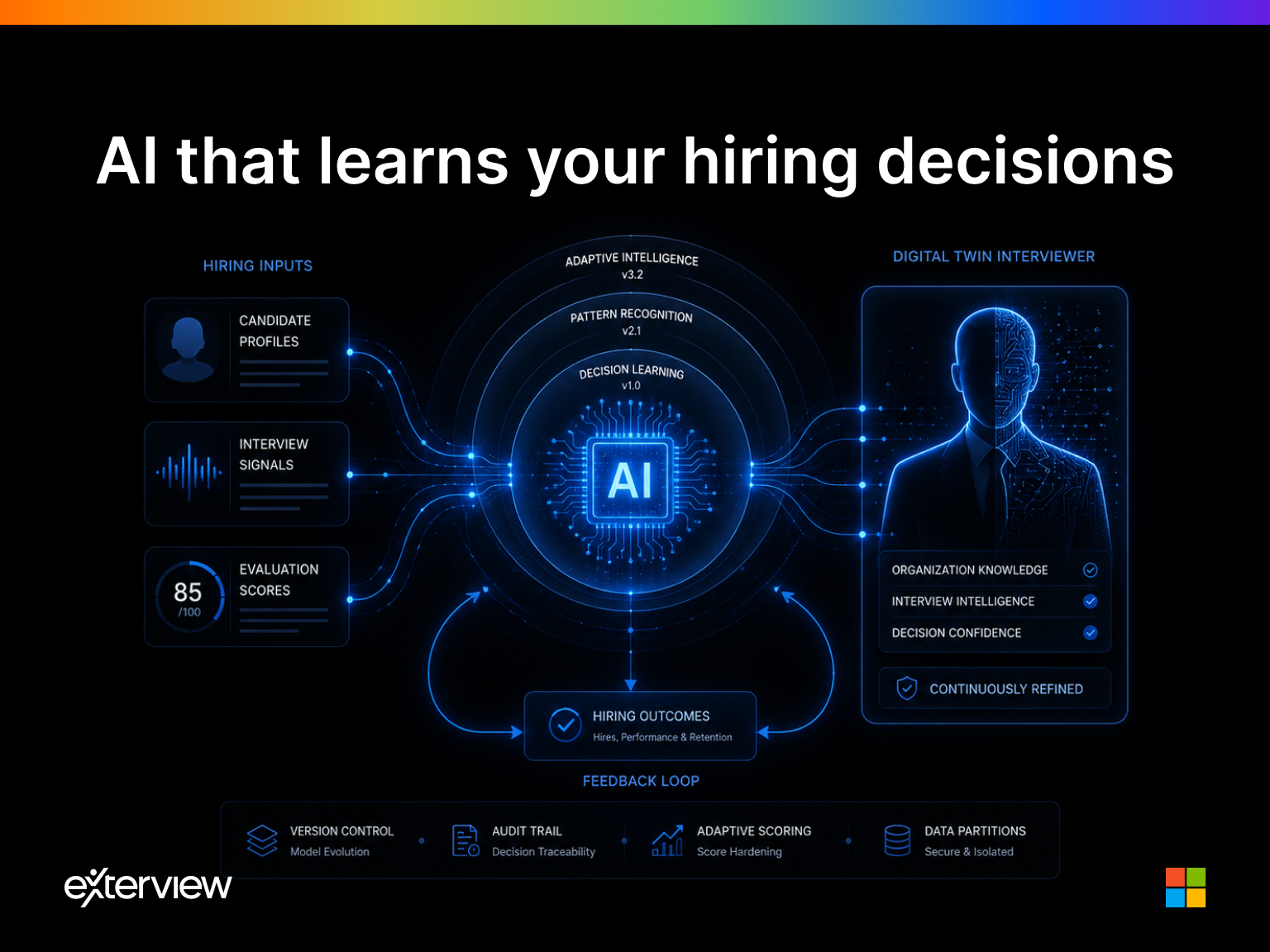
5. The 90-day post-hire loop. This is where the system compounds. Exterview links the pre-hire evaluation to post-hire performance signal, then adjusts the organization's scoring model against its own outcomes. Every hire makes the next evaluation more accurate for that specific organization.
Work IQ improves the input quality on the post-hire side, where ramp evidence, project participation, and contribution context are semantic rather than structured — precisely what a performance field in an HRIS fails to capture. The loop itself is ours, runs per tenant, and works on both paths.
That is the difference between a generic skills graph and an organizational one. A generic model tells you what the market considers a strong candidate. Exterview learns what a strong candidate looks like at your company, and can show you which evaluations changed its mind.
Where the two ontologies meet
Work IQ's business-understanding layer captures procedural knowledge from an organization's workflows through ontologies and glossaries. Exterview maintains a per-tenant context graph of a customer's own roles, competencies, evaluation standards, and hiring outcomes.
These are complementary rather than overlapping. Microsoft models how your business operates. We model how your organization judges talent. The second is only defensible if it belongs to you, which is why the scoring model is per-tenant and the evidence trail is yours to export.
How the platform is built
These capabilities are not one large model behind a chat box. Exterview runs a catalogue of twenty-six sub-agents across eight layers — design, sourcing, screening, trust, operations, knowledge, candidate, and post-decision — each declaring its own tool calls, connectors, output schema, permission requirements, and evaluation status.
Every agent is inspectable in the product. When procurement asks what your AI can touch, the answer is a screen, not a slide.
The platform runs on Azure, with tenant-partitioned storage, durable orchestration for every agent handoff, and schema-pinned model output so an evaluation cannot silently change shape between runs.
Governance and commercial mechanics
Enterprise buyers ask two questions immediately. Both have direct answers.
Where does the data sit? Exterview runs on Azure. Work IQ queries execute inside the customer's own Microsoft 365 tenant under existing conditional access, permission, sensitivity-label, and DLP controls. Exterview does not replicate tenant content into a separate corpus.
Who pays for the intelligence layer? Work IQ API usage is billed through a consumption model using Copilot Credits, with no separate subscription, SKU, or per-user licence. An administrator must enable consumptive billing in the Microsoft Admin Center before usage begins, and we recommend configuring access policies, spending caps, and alerts at the same time. Consumption sits with the customer and stays governed by the customer. Our implementation team runs this configuration during onboarding.
Customers on Exterview Core incur none of this. There is no consumption dependency on that path.
Where this goes
Talent systems have spent twenty years getting better at storing claims. The opportunity now is to get better at evaluating evidence, and at closing the loop between a decision and its outcome.
Our objective is a talent platform where every evaluation traces to evidence, every model belongs to the organization that owns it, and every hire improves the next one.
Exterview is available today for organizations on Microsoft 365, and for organizations that are not.
https://marketplace.microsoft.com/en-in/product/exterviewinc2026.exterview-ai?tab=PlansAndPrice
Book a Demo and Get a Private offer! ( https://www.exterview.ai/ )
Note: Microsoft, Microsoft 365, Azure, Dynamics 365, and Work IQ are trademarks of the Microsoft group of companies. This post describes both capabilities available today and capabilities under active development, marked individually above. Statements about future functionality reflect current plans and are not commitments; timelines and scope may change. Nothing here forms part of any agreement.
This blog is a part of a Series "What's next with Exterview"

Manish Surapaneni